


BETAFPV SuperX ELRS Gemini Xross NANO Receiver (2.4G+868M)

£24.99
The SuperX Nano uses dual Semtech LR1121 chips for 868MHz Gemini, 2.4GHz Gemini and simultaneous dual-band GemX operation. Supplied with two dual-band T antennas, it’s suited to racing, freestyle and long-range builds.
In stock
BETAFPV SuperX ELRS Gemini Xross NANO Receiver (2.4G+868M)
This is the BETAFPV SuperX ELRS Gemini Xcross receiver. Built around Semtech’s LR1121 RF technology and Espressif’s ESP32-C3 MCU, the BETAFPV SuperX is the company’s first Gemini Xrossband ELRS receiver.
Depending on the version, it supports 2.4GHz paired with either 868MHz or 915MHz, with LoRa and high-speed FSK modes up to 1,000Hz. Choose the SuperX Nano for dual-band Gemini reception, or the SuperX Mono for a compact receiver that switches between 2.4GHz and 900MHz. Designed for racing, freestyle and long-range builds, SuperX offers flexible link options for different flying styles.

Product Highlight’s
- Semtech LR1121 RF chips + Espressif ESP32-C3
- LoRa and blistering 1000Hz FSK modes
- Supports 900M Gemini, 2.4G Gemini, 900M+2.4G GemX
- SuperX Nano: Dual-band mastery for RF-challenged environments
- SuperX Mono: Band-switching for micro builds
- Works with Micro/Micro V2/Nano V2/SuperG TX modules
- Compact and lightweight
Product Information
| SuperX Mono RX | SuperX Nano RX | |
| MCU | ESP32-C3 | |
| Telemetry Power | 20dBm | |
| Input Voltage | 5V | |
| Protocols | CRSF, SBUS, SUMD, DJI RS2 Pro, MAVLink | |
| RF Chip | Single LR1121 | Dual LR1121 |
| Reception Mode | Single | Diversity/Gemini |
| Frequency Band | 900M/2.4G | 900M+2.4G |
| Antenna Connector | U.FL x1 | U.FL x2 |
| Weight | 0.82g | 1.45g |
| Dimensions | 12.3 x 18.6mm | 16.3 x 21.4mm |
| LUA Name | BFPV SuperX Mon | BFPV SuperX Nan |
| Recommended | 2”- 5” drones (racing, freestyle, long-range) | 5” + drones (freestyle, photography, long-range) |
Diagram
SuperX Nano Receiver:
The SuperD receiver 2.4GHz version diagram is shown below.
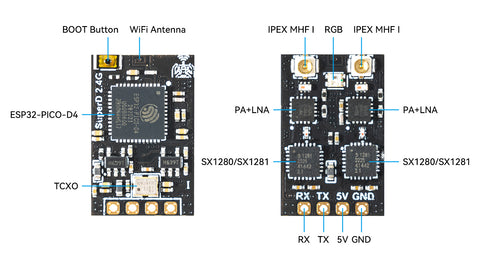
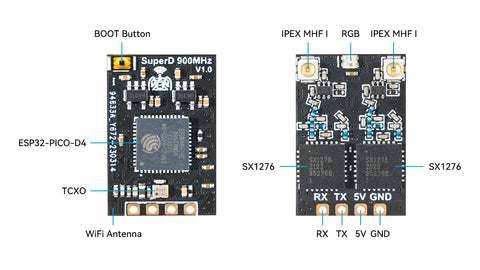
Gemini
ExpressLRS Gemini revolutionizes RC control by leveraging true diversity hardware to simultaneously transmit across 2.4GHz and/or 900MHz frequencies. Unlike conventional systems, Gemini utilizes dual independent transmit/receive chains – delivering superior link quality (LQ) that thrives in challenging environments like race courses or urban areas.

Gemini offers three modes: 900M Gemini, 2.4G Gemini, and 900M+2.4G Gemini Xrossband (GemX). With GemX, you no longer need to choose between performance traits—it combines 2.4GHz’s low latency and 900MHz’s long-range in a single, seamless link.

Note: The GemX mode requires a dual-band TX.
SuperX Nano: 900M+2.4G Dual Band
Powered by dual LR1121 chips from Semtech, the SuperX Nano Receiver delivers uncompromising signal reliability with three modes: 900M Gemini (long-range penetration), 2.4G Gemini (ultra-low latency), and 900M+2.4G GemX (simultaneous operation). The included dual-band T antennas eliminate frequency-switching hassles, while advanced diversity processing ensures rock-solid stability in RF-challenged environments. Built for mission-critical applications, it’s the ultimate solution for competitive racers, long-range explorers, and professional aerial photographers who demand zero-compromise performance.

SuperX Mono: Band-switching Agility
The compact and lightweight SuperX Mono Receiver harnesses a single LR1121 chip with a dual-band antenna, enabling seamless switching between 900M and 2.4G. This cost-effective solution maintains impressive 1000Hz packet rates (in FSK mode) while offering exceptional value, making it ideal for micro builds and budget-conscious pilots who need versatile performance in both close-range freestyle and long-distance applications.

TX Compatibility


SuperX vs. SuperD vs. Nano
| SuperX RX | SuperD RX | Nano RX | |
| MCU | ESP32-C3 | ESP32-PICO-D4 | ESP8285 |
| RF Chip | Dual LR1121, LR1121 | Dual SX128X (2.4G), Dual SX1276 (900M) | SX128X (2.4G), SX1276 (900M) |
| Antenna Mode | Gemini, single | True diversity | Single |
| Frequency | 900M+2.4G, 900M/2.4G | 2.4G/900M | |
| Telemetry Power | 20dBm | 20dBm (2.4G) / 17dBm (900M) | |
| Modulation | LoRa, FSK | LoRa, FLRC | |
| Serial Output Protocol | CRSF, SBUS, SUMD, DJI RS2 Pro, MAVLink | ||
BETAFPV ExpressLRS Receivers
Choosing the right receiver is critical for optimal FPV performance. BETAFPV’s ExpressLRS lineup offers tailored solutions for every pilot: ELRS Lite, Micro, Nano, SuperP, SuperD, and the newest SuperX. From whoop racing to long-range cinematography, we engineer the low-latency links and interference-proof performance you demand.
Configuration


The SuperX Receiver currently supports CRSF/SBUS/SUMD protocols. The following takes CRSF protocol as an example to introduce its connection and pin configuration with Betaflight firmware flight controller.
Wiring diagram:
JST SH connector pin configuration:
Note: Betaflight and ExpressLRS use different JST SH connector pin configurations. Betaflight: 5V (V+), GND, RX, TX; ExpressLRS: GND, 5V (V+), TX, RX. When using the terminal wires for connection, please check the sequence.
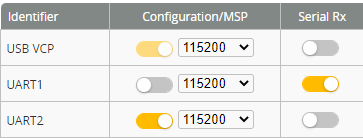
Connect the flight controller to the Betaflight Configurator for basic configuration. First, on the “Port” tab, enable the flight controller serial port like UART1 as Serial Rx.
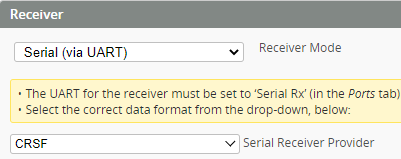
On the “Configuration” tab, set Receiver Mode to Serial (via UART) and Serial Receiver Provider to CRSF.
Bind
The SuperX Receiver uses ExpressLRS V3.x official protocol as its default firmware without a pre-set binding phrase. For successful operation, ensure the transmitter module also uses ExpressLRS V3.x or later firmware with no pre-set binding phrase.
- Power-cycle the receiver 3 times with a 1-second interval or press and hold the BOOT button for 2 seconds to enter binding mode.
- The RGB indicator flashes orange twice, which indicates the receiver is in bind mode.
- Configure remote control or transmitter module to bind with the receiver. If the RGB indicator is a solid light, it’s bound!
Notes:
- After binding once, the receiver will remember the autosaved binding phrase and device. Further restarting of the device will be bound automatically without the need for a rebinding process.
- If you have flashed firmware to the SuperX and configured the binding phrase, you will not be able to bind using the method above. Please set the same binding phrase for the transmitter module, this allows the receiver to be bound to the device automatically.
- It is recommended to place the two antennas as far apart as possible for better reception.
Know More About ExpressLRS
ExpressLRS is an open-source RC link for RC applications. Everyone could find this project on Github or join the discussion in Facebook Group.
File
User Manual for BETAFPV SuperX ELRS Gemini Xross Receiver
Firmware for SuperX ELRS Gemini Xross Receiver
How to flash the firmware of SuperX Receiver via Passthrough or WIFI?
To minimize GPS interference when using 868MHz, X150, or LowBand packet rates, avoid setting the telemetry ratio to 1:2 unless absolutely necessary—especially at 100mW telemetry power.
If you require MAVLink or a 1:2 telemetry ratio, please position the SuperX receiver as far as possible from the GPS and avoid pointing the receiver antenna toward the GPS during satellite acquisition.
In the box
Item: SuperX ELRS Gemini Xross Receiver – Nano
- 1* SuperX Nano Receiver
- 2* Dual-band T Antenna
- 1* SH1.0 Connector (Double Ended)
- 2* Heat Shrink Tubing
- 1* User Manual
| Weight | 79 g |
|---|
Related products

Radio Receivers

Radio Receivers

Radio Receivers
